

Legal Guide to Retrenchment and Layoff Reserve under Employment Laws of Nepal
Managing labor costs through retrenchment and holding workers in reserve (layoff) are critical mechanisms employers may need to adopt in challenging business scenarios. Under Nepal’s Labor Act 2074 (2017) and related laws, the process of workforce reduction is tightly regulated to protect employee rights and ensure fair compensation. This guide presents an overview of legal provisions employers and employees should be aware of when retrenchment or layoff reserve becomes necessary.
Understanding Retrenchment
Retrenchment refers to the permanent reduction of workforce through termination, generally due to economic or organizational reasons beyond the employer’s control. Typical grounds for retrenchment are financial difficulties, mergers leading to redundant workers, or partial/complete business closure.
The Labor Act mandates a clear procedure for retrenchment, including:
- Notification: Employers must provide at least 30 days’ advance notice to the Labor Office and active trade unions or Labor Relation Committee (LRC).
- Discussions: Mandatory consultations with trade unions or LRC must occur, covering alternatives to retrenchment and criteria for selecting employees to be retrenched.
- Order of Selection: Retrenchment priority follows a legal order starting with foreign workers, workers with more disciplinary punishments, weaker performers, and lastly those most recently hired.
- Compensation: Employers must pay one-month basic salary for each completed year of service as severance, prorated for employees with less than one year’s service, unless unemployment allowances are available (currently not provided under social security laws).
- Contractual Employees: Retrenchment applies equally to contractual employees, with compensation obligations if the contract period exceeds one year.
Procedures and Key Conditions
The retrenchment decision must be well-documented, with board resolutions or management minutes substantiating the grounds. Failure to adhere strictly to procedural requirements, such as notification and consultation, can lead to litigation and overturning of retrenchment decisions.
Employers should also consider alternatives reasonably and document these considerations thoroughly. The legal framework ensures due process and seeks to minimize arbitrary terminations.
Holding Labor in Reserve (Layoff)
Layoff reserve differs from retrenchment in being temporary. It applies when workplace operations are suspended temporarily due to reasons beyond the employer's control, such as power shortages, raw material scarcity, machinery breakdowns, or natural disasters.
Key points about layoff reserve:
- Employment relationship continues during the reserve period.
- Maximum reserve period is 15 days, but extensions require consultation with unions or LRC.
- Employees receive half of their basic salary (excluding some allowances) during this period.
- Notice must be given specifying the reason, duration, affected employees’ details, and payment terms.
- Social security contributions continue to be made during layoff.
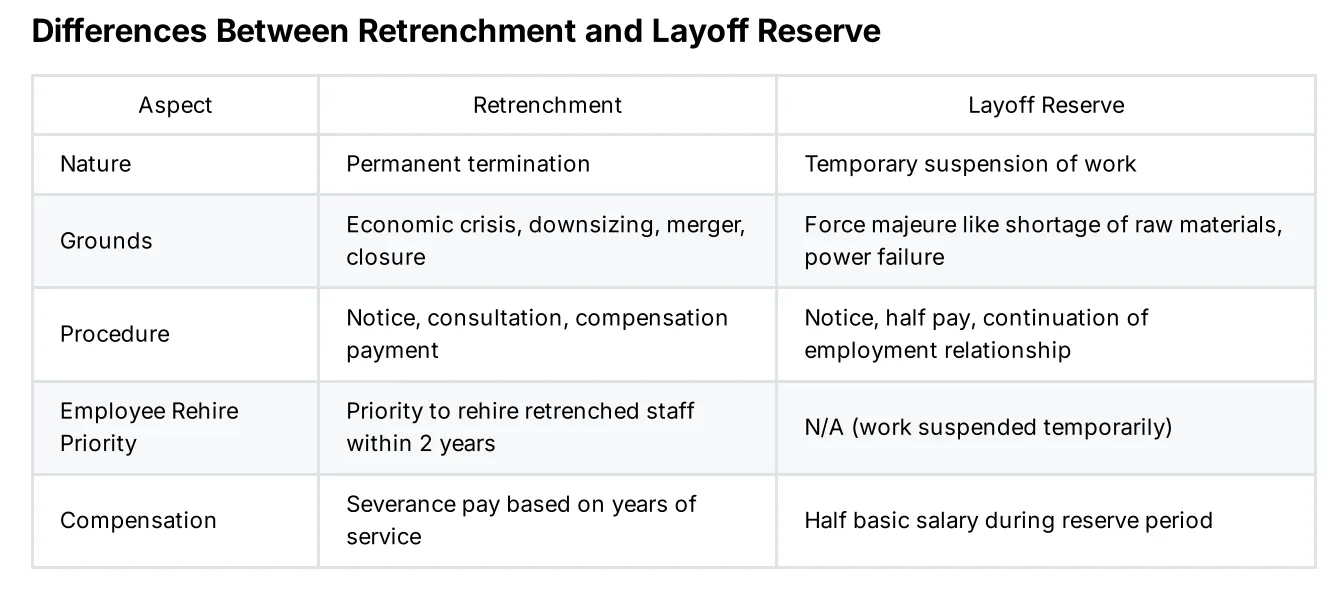
Differences Between Retrenchment and Layoff Reserve
- Retrenchment is the permanent termination of employees, while layoff reserve is a temporary suspension of work.
- Retrenchment happens due to financial difficulties, mergers, or closure; layoff reserve happens due to uncontrollable events like raw material shortage or power failure.
- Employees retrenched receive severance pay based on years of service; employees on layoff reserve get half of their basic salary during the suspension.
- Retrenchment requires prior notice, consultation, and strict procedure; layoff reserve requires a notice mentioning reason, time period, and payment details.
- Retrenched employees may be rehired with priority if the enterprise reopens within 2 years; employees on reserve maintain continuous employment but work is temporarily stopped.
- Retrenchment ends the employment relationship; layoff reserve keeps the employment relationship intact during the reserve period.
Practical Considerations for Employers
- Documentation is critical. Decisions should be backed by clear evidence and management resolutions.
- Compulsory consultation with trade unions or LRC must be respected.
- Alternatives to retrenchment should be properly considered and minuted to withstand legal scrutiny.
- Payment of retrenchment compensation remains mandatory until unemployment allowances are introduced.
- Employers should notify and coordinate with the Social Security Fund to avoid complications regarding contributions during reserve periods.
This legal guide aims to empower enterprises with knowledge of proper labor force management under Nepal’s applicable laws while safeguarding employee rights. Both employers and employees should be aware of their rights and obligations to ensure fair, lawful, and transparent retrenchment or layoff processes.
If more details or legal advice is needed, consulting a qualified legal professional familiar with Nepal's labor laws is recommended.